
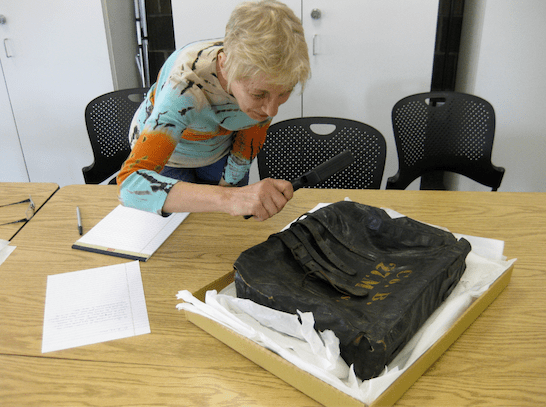
My interest in potential at the intersection of public history and healthy aging is rooted in my mother’s collection of local history artifacts, which were steadily put to good use in support of programming at a community senior center. Struck by the benefits for aging residents of care facilities of engaging with historic artifacts, in 2014 I collaborated with museum educator Betty Sharpe on the project “Making Memories Matter” which, with funding from a University of Massachusetts Amherst Public Service Endowment grant, partnered with the Amherst, Massachusetts historical society to bring objects from museum collections into a variety of senior-serving institutions. That work is reported in “‘Artifact Stories:’ Making Memories Matter for Amherst Seniors,” in Hamish Robertson, eds. The Caring Museum: How Older People Contribute to Museums (Edinburgh and Boston: MuseumsEtc, 2015), with Elizabeth Sharpe, and was presented in the session “Creative Aging, Inclusive Aging: How Public Historians Can Reach Seniors in New Ways,” NCPH annual meeting, Baltimore MD, March 2016.
That work was reprised with colleagues and students at UMass Amherst in later years, but the next major initiative in that area was the NCPH Working Group “Uniting Public History and End of Life Care,” a yearlong effort that resulted in a lively session at the organization’s annual meeting.
Most recently, as Dean of Strategic Initiatives at UMass Amherst, I brought together faculty, staff and students who shared these interests together in an initiative to advance the “Humanities of Health and Wellbeing.” Aligned with those aims and an outgrowth of them, myself and colleagues in the UMass School of Public Health and Health Sciences and other units secured grant funding to launch the HEART Center, which seeks to entangle Health, Environment, and the ARTs. The center aims to bring together researchers from diverse academic fields, including public health, history, education, and art, to address complex societal problems related to health and environmental inequities using arts-based methods. For more information, visit the project blog, HEARTBeats: A Pulse for Action.
 Throughlines